Blog · Template
A roommate move-out handover checklist for a shared home
A roommate move-out handover checklist should separate the leaving date, shared costs, open household work, belongings, access items, and final checks. Give every unresolved item an owner and an outcome so the person leaving can hand over cleanly without the remaining household rebuilding the arrangement from messages and memory.

A roommate move-out handover checklist should separate the leaving date, shared costs, open household work, belongings, access items, and final checks. Give every unresolved item an owner and an outcome so the person leaving can hand over cleanly without the remaining household rebuilding the arrangement from messages and memory.
This is not the same as moving the whole household. One person is leaving while the home continues. The checklist therefore has two jobs: close what belonged to the old arrangement and make the continuing arrangement understandable to the people who remain.
What should roommates agree before the move-out date?
Start with the boundaries that change every other action:
- Last occupancy date: the final day the leaving roommate expects to use the home.
- Removal window: when personal belongings will leave and whether another visit is expected.
- Shared-item decisions: what stays, what leaves, and what still needs a decision.
- Final cost dates: which shared costs still cover the departing roommate and when that responsibility ends.
- Access return: the keys, passes, or other access items that need a recorded handover.
- Room and shared-space condition: the specific cleaning or repair outcomes everyone expects.
Write uncertain matters as decisions rather than pretending they are tasks. Sivella keeps a decision's options, constraints, and ownership together. If the household has not decided who keeps a shared appliance, record the options and name who will close the choice before creating a pickup action.
How should shared costs and belongings be closed?
Use one line for each unsettled item. Record the amount or object, the period or place it relates to, who will move it next, and what counts as closed. Keep an estimate marked as an estimate. A message saying “we will work it out later” is not an outcome.
Sivella's budget ledger tracks goals, upcoming spending, and tradeoffs. It can keep the financial context visible beside the move-out decisions it affects, but the checklist should not become a second accounting system. Record the practical choice and the next action: confirm the final amount, transfer ownership of a shared purchase, or deliberately leave an item with the household.
For belongings, walk through shared rooms rather than relying on memory. Separate clearly personal items from things bought or used together. Photographing or cataloguing everything is usually unnecessary; give attention to objects whose ownership is genuinely unclear or whose removal changes what the household must replace.
Which unfinished household work needs a handover?
Review work the departing roommate currently owns: recurring chores, an open repair, a delivery they arranged, a bill follow-up, or a decision waiting on their answer. For each item, choose one of three outcomes: finish it before leaving, transfer the next step, or dismiss it because the old arrangement no longer needs it.
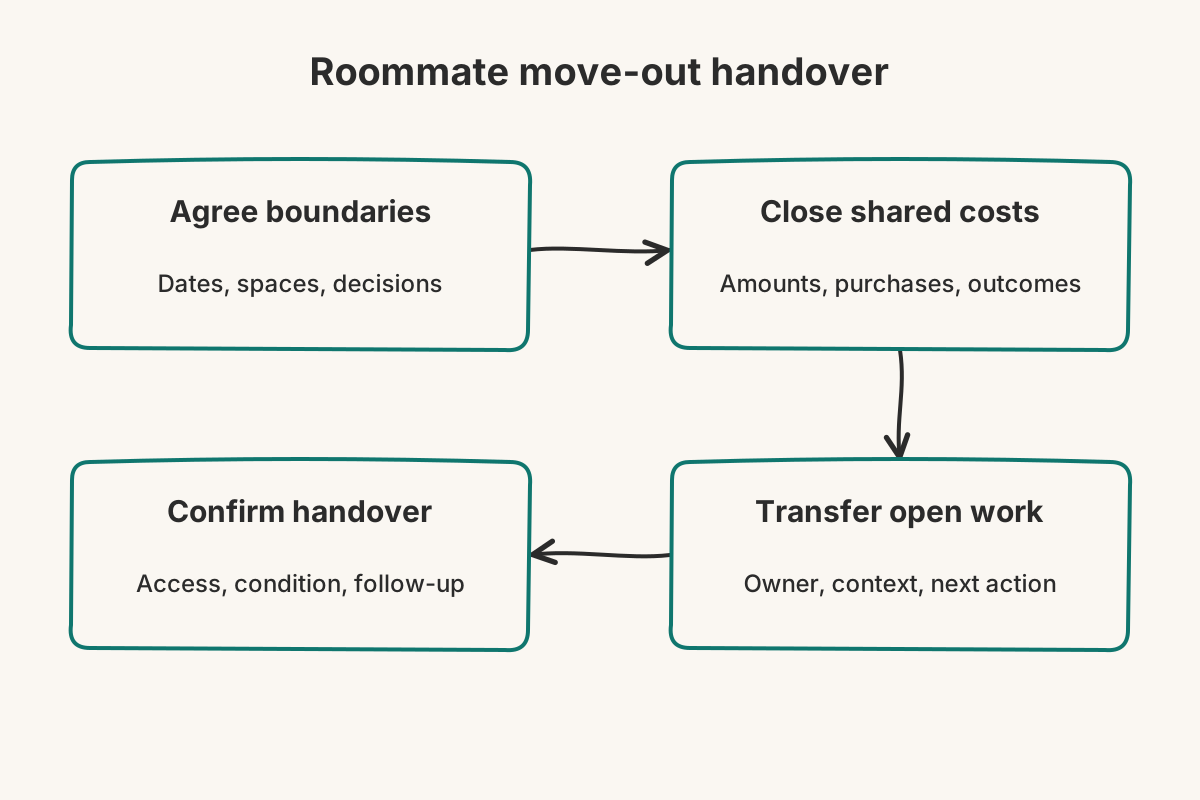
Use this order for the whole handover:
- Agree boundaries — settle dates, spaces, and what still needs a decision.
- Close shared costs — record the outcome for each remaining shared amount or purchase.
- Transfer open work — give every continuing action a new owner and the context needed to move it.
- Confirm handover — record access returns, room condition, and any deliberately open follow-up.
Sivella tasks carry an owner, and its working loop is capture, clarify, assign, and follow through. A transfer is complete only when the new owner can see the next action and its relevant constraint. “Alex knows about the repair” is weaker than recording which quote is outstanding and who will chase it.
What belongs in the final roommate handover check?
Do the final check against outcomes, not effort. Confirm that access items were returned, agreed belongings left or stayed, shared spaces reached the expected condition, and each remaining cost or task has a visible status. If something cannot close that day, give it one owner and a date or condition for returning to it.
Remove recurring reminders that belonged only to the departing roommate, or reassign the household work they represented. Sivella supports recurring rhythms and one-off nudges, so a continuing routine can move to another owner while a final collection or confirmation remains a temporary reminder.
The handover is done when nobody needs the departing roommate's memory to understand what remains. The home may still have a loose end. What matters is that the loose end is named, owned, and visible instead of quietly becoming the remaining household's surprise.