Blog · Template
A moving house checklist for people living together
A moving house checklist for people living together should separate decisions, costs, dates, and physical jobs, then give every next step an owner. Sivella keeps tasks, calendar availability, budget tradeoffs, reminders, and decisions in shared household context, so the move can continue without one person holding the complete plan.

A moving list can look complete while concealing the work between its lines. “Pack kitchen” says nothing about what stays usable on the final night. “Collect keys” does not say who will carry them. “Change address” can expand into twenty small contacts with no order.
Separate the move into choices, money, timing, packing, and handover. Each broad instruction then becomes a finishable action that can pass from one person to another.
What should you settle before packing begins?
Record the boundaries that alter everything downstream:
- Date or window: what is confirmed, what remains flexible, and the event that will settle it.
- Route: self-move, hired transport, or another genuine option still being considered.
- Inventory boundary: what comes along, what leaves before departure, and what needs a later verdict.
- Spending boundary: known charges, likely purchases, and the household goal each cost may displace.
- First-night minimum: the rooms, services, bedding, food, medicine, and tools that must remain reachable.
Open a separate decision for anything that blocks several later actions. Sivella's decision area holds options, constraints, and ownership together. Its budget ledger tracks goals, upcoming spending, and tradeoffs. A transport quote can therefore sit beside the money choice it creates rather than becoming an isolated message somebody must remember.
Do not pretend an estimate is final. Write the amount as quoted, the gaps still unknown, who will find the missing detail, and when the household will choose. Packing can begin while a decision is open; tasks that depend on its answer should not masquerade as ready.
How do you divide the physical move?
Break work by place and finish line, not by a vague department. Try these groups:
- Old home: clear each room, clean the released area, record final readings, return access items, and complete the condition check.
- New home: collect access items, confirm essential services, identify immediate faults, prepare somewhere to sleep, and make one bathroom usable.
- Transport: confirm volume, protect fragile pieces, plan awkward items, reserve loading space, and name the person carrying essentials.
- Administration: complete only the address changes, cancellations, and new arrangements that have an active deadline.
Make packing room-specific. Keep an “open until departure” line for chargers, cleaning tools, basic cookware, bedding, medicines, and inspection supplies. Mark anything fragile, temperature-sensitive, unusually heavy, or impossible to replace quickly. Those descriptions tell the next person more than “miscellaneous” ever will.
Put one name beside the immediate action. Sivella tasks carry an owner. Its loop is capture, clarify, assign, and follow through, which fits a move because responsibility changes at every handoff. Requesting a quote does not make that person responsible for booking, payment, access, and checking the result.
Which moving dates deserve their own reminder?
Use a one-off reminder when a single timed action could otherwise vanish between stages: confirm key collection, take a reading, release a booking, check a deposit, or chase a promised document. Sivella supports one-off nudges as well as recurring rhythms. Most moving reminders should end once handled rather than becoming permanent household routines.
For appointments, first find a window that actually works. Sivella shares calendar availability as free or busy and does not expose event details. That is enough to choose between collection slots, inspection times, and delivery windows without asking anyone to explain a private appointment.
Write reminders as observable actions. “Worry about utilities” is a feeling. “Confirm the start date” is something another person can complete. Add the reference or constraint the action needs, but keep private explanations out of shared operational notes when they are not required.
What closes each stage of a shared move?
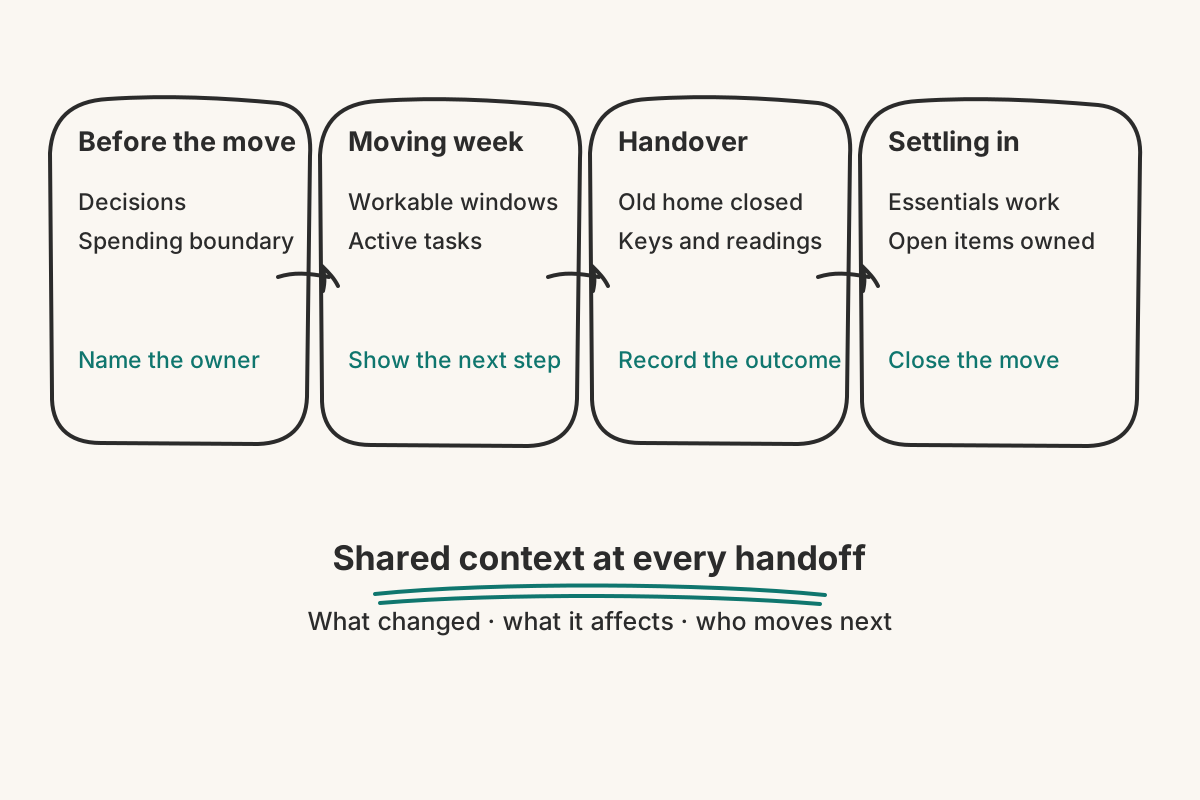
Use four closing checks:
- Before the move: dates have a status, major choices have an owner, and uncertain costs are visible.
- Moving week: every active packing or transport action has a finish line and the essentials remain reachable.
- Handover: keys, readings, access, condition, and remaining obligations have recorded outcomes.
- Settling in: essential rooms work, urgent faults have an action, and every loose end is owned or deliberately dismissed.
“Appointment completed” is not an outcome if the promised key did not arrive. “Boxes moved” is not an outcome if nobody can find the medicine bag. Close the actual obligation, then remove the stale reminder.
The checklist is finished when the old-home obligations are closed and the new-home loose ends no longer rely on oral history. The move may still feel unsettled. What matters is that anybody involved can identify what remains, what constrains it, and who moves it next.