Blog · Template
A household decision record template that keeps the next step visible
A household decision record should keep the question, options, constraints, owner, next step, and final choice together. Use one record for each decision, name who will move it, and close it with the reason that mattered. Sivella keeps those parts in shared context so the household can continue without restarting the conversation.

A household decision record should keep the question, options, constraints, owner, next step, and final choice together. Use one record for each decision, name who will move it, and close it with the reason that mattered. Sivella keeps those parts in shared context so the household can continue without restarting the conversation.
The record is for choices with consequences beyond one person: which repair quote to accept, whether to replace an appliance, how much to set aside for a move, or which evening works for a recurring commitment. It is not needed for every preference. Its job is to leave enough context that another household member can understand where the choice stands.
What belongs in a household decision record?
Copy this structure for each open decision:
- Question: Write the choice as something that can be answered. “Kitchen floor” is a subject; “repair the damaged section or replace the floor?” is a decision.
- Owner: Name the person responsible for moving the choice to its next point. Ownership does not mean deciding alone.
- Options: Keep the real alternatives, including waiting or doing nothing when either is genuinely available.
- Constraints: Record the limits that remove options: budget, timing, measurements, availability, or an agreed household priority.
- Next step: Name the smallest action that would produce useful information or a choice.
- Review point: Add the date or event that brings a parked decision back.
- Final choice and reason: Close the record with what the household chose and the constraint or priority that settled it.
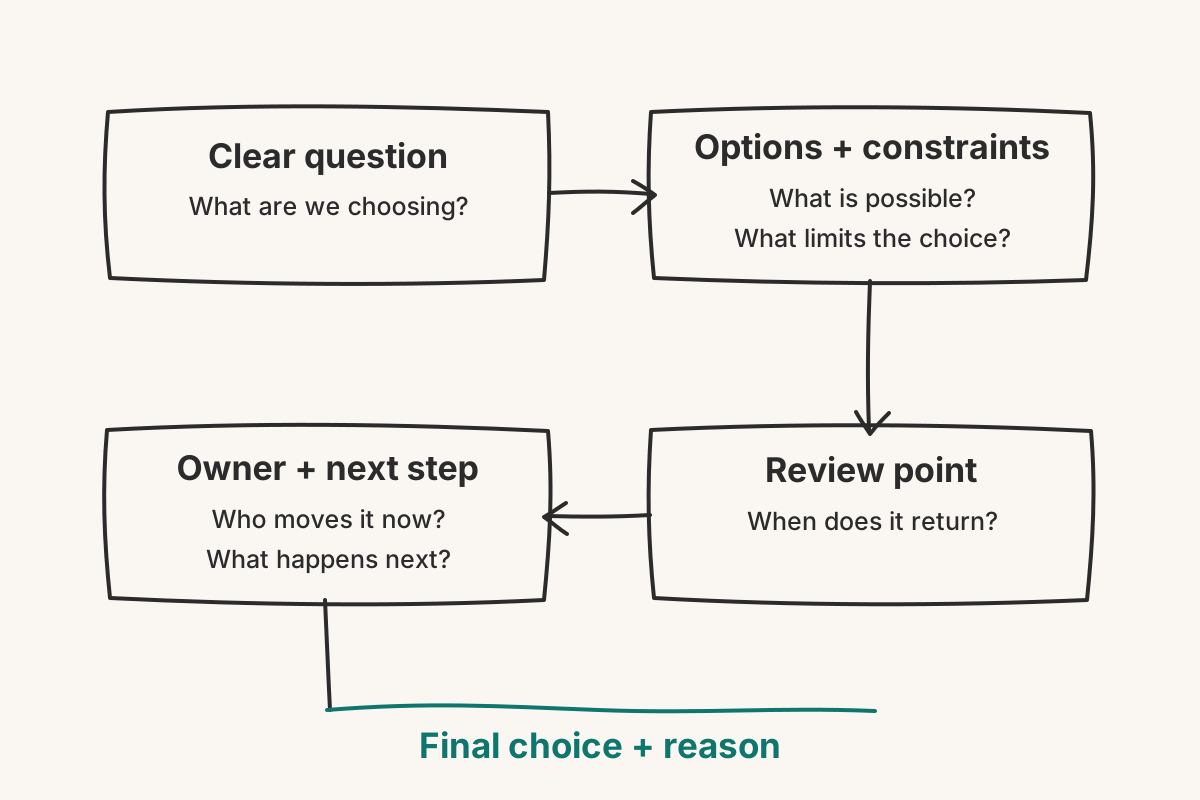
Sivella's decisions keep options, constraints, and ownership together. The wider household loop is capture, clarify, assign, and follow through, so an open choice remains connected to what has to happen next rather than becoming a note that simply describes the problem.
How should you write options and constraints?
Write options so they can be compared. “Get it sorted” cannot be weighed against anything. “Accept the repair quote,” “request one more quote,” and “replace the appliance after the current billing cycle” are separate paths with different effects on time and money.
Then separate constraints from preferences. A fixed opening width is a constraint. A finish someone likes is a preference. Upcoming spending can also be a constraint when it changes what the household can commit to now. Sivella's budget ledger tracks goals, upcoming spending, and tradeoffs, which helps keep the money pressure beside the decision it affects.
Do not collect information without deciding what it will change. If another quote is the next step, write which uncertainty it should resolve. Otherwise research can expand while the choice stays exactly where it was.
Who should own the next step?
Choose one owner for the immediate movement, even when the final call belongs to several people. A shared decision without an owner often waits because everyone can see it and nobody knows who is expected to act.
Keep that ownership narrow. The person requesting a measurement does not automatically own the purchase, installation, and every future problem. After the measurement arrives, the next step can move to someone else. Sivella keeps ownership with the decision context, making that handoff visible rather than leaving it in a conversation.
If the household is not ready to choose, replace a vague “later” with a review point. A date, the arrival of a quote, or the end of another commitment can all reopen the record. Waiting becomes an explicit state instead of an unfinished discussion returning at random.
When is the household decision finished?
Close the record when the choice is made or intentionally dismissed. Record the final call and one sentence about why it won. The reason matters because a later question is often not “what did we choose?” but “what did we know when we chose it?”
Keep the explanation proportionate. The constraint that settled the matter is more useful than a transcript of the whole conversation. Sivella's household memory is inspectable and editable, so stale context can be corrected rather than treated as permanent truth.
A good decision record does not make a household more formal. It makes repetition less necessary. The choice, its limits, and its next movement stay visible, so the person who happens to remember the most does not have to reopen the meeting each time the subject returns.