Blog · Template
A household responsibility handover checklist that transfers the whole job
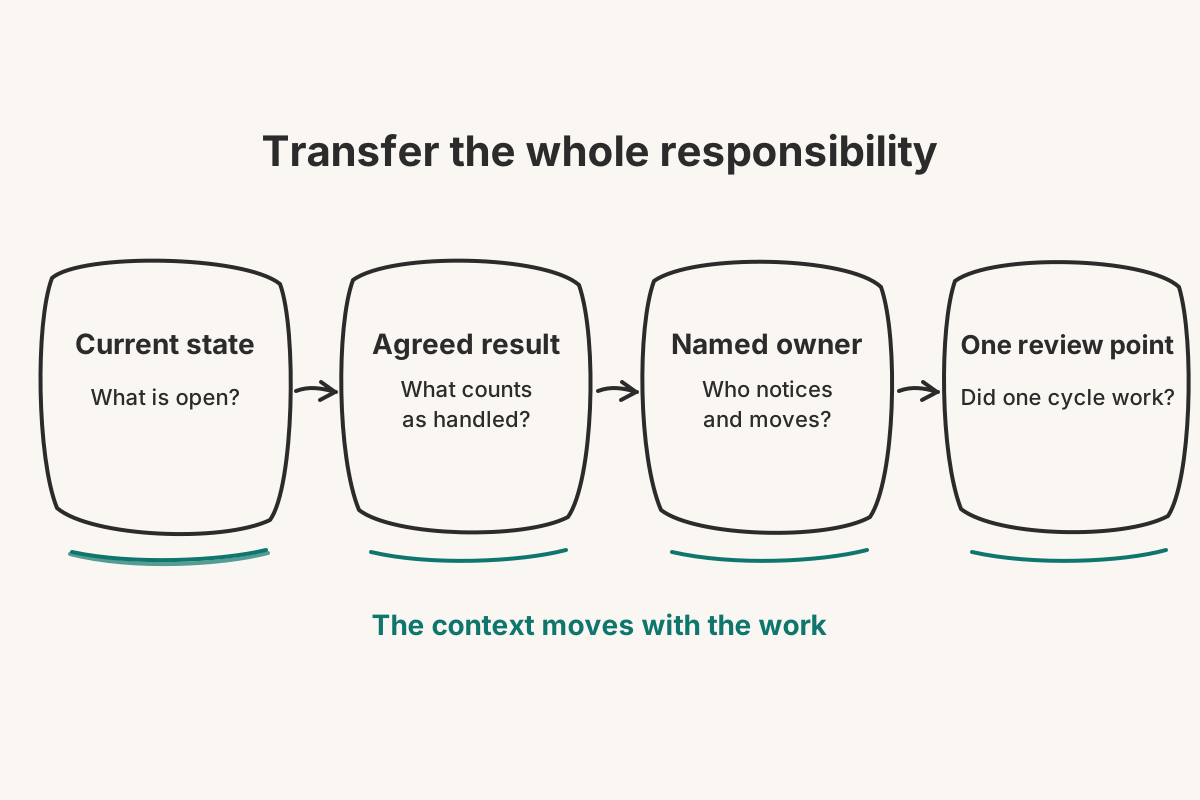
A household responsibility handover should transfer the noticing, planning, decisions, action, and follow-up—not only the final chore. Agree on the result, move the useful context into a shared place, name one owner, and set one review point. The previous owner can then step back without leaving the new owner to reconstruct the job.

A household responsibility handover should transfer the noticing, planning, decisions, action, and follow-up—not only the final chore. Agree on the result, move the useful context into a shared place, name one owner, and set one review point. The previous owner can then step back without leaving the new owner to reconstruct the job.
Use this for a whole area that has quietly settled with one person: laundry supplies, routine home maintenance, meal planning, household renewals, or arranging service visits. Start with one area. Moving every responsibility at once creates a new coordination job before either person has learned what a complete handover feels like.
What are you actually handing over?
Name the responsibility by its outcome, not by its most visible action. “Do the grocery shop” transfers a trip. “Keep the household supplied for the meals we have planned” includes noticing what is low, maintaining the list, choosing when to shop, making the purchase, and dealing with anything missed.
Copy these fields for the handover:
- Responsibility: the area that is moving.
- Agreed result: what being reliably handled looks like.
- Usual triggers: the date, condition, or event that starts the work.
- Current state: what is complete, open, waiting, or due next.
- Known constraints: timing, availability, budget, or an earlier household decision.
- New owner: the person who will notice and move the work.
- First next step: the smallest useful action after the handover.
- Review point: one date to check whether the arrangement is workable.
The agreed result matters more than matching the old method. If both people need clean work clothes available each Monday, that is the shared standard. The exact washing day may belong to the new owner.
What context should move with the responsibility?
Transfer only information that changes an action. The current repair state, the date a renewal returns, the spending boundary for supplies, or the reason one option was ruled out may matter. A complete history of every earlier attempt probably does not.
Put each kind of context where it can keep doing its own job. In Sivella, tasks carry an owner. Recurring reminders can hold a rhythm, while one-off nudges can cover a temporary follow-up. The budget ledger holds goals, upcoming spending, and tradeoffs. Decisions keep options, constraints, and ownership together. The handover does not need one enormous note when the live parts can remain visible in the household record.
Then run the first item through Sivella's capture, clarify, assign, and follow-through loop. Capture the matter, clarify the immediate movement, assign it to the new owner, and leave it active until there is a result or an intentional decision to drop it.
How do you stop the work from bouncing back?
The old owner should not remain the private source of dates, contacts, standards, and reminders. If the new owner has to ask for each next instruction, the visible action moved while the management stayed behind.
Agree on three boundaries before stepping back:
- Questions go to the shared context first. Add a missing operational fact there so it becomes available next time.
- The new owner chooses the method. Revisit the agreed result if needed, rather than correcting harmless differences in execution.
- Problems create a next step, not an automatic return. A missed refill might produce a changed reminder or a clearer trigger. It does not silently restore the previous arrangement.
A shared system cannot create willingness. If someone will not accept responsibility or repeatedly leaves agreed work untouched, that is not a visibility problem. The record can make the state plain, but the household still needs a direct conversation about commitment.
When should you review the household handover?
Choose a review point that allows the responsibility to complete one real cycle. At that check, ask whether the new owner could see the trigger, find the needed context, make ordinary decisions, and close the follow-up without supervision. Also ask whether the previous owner actually stopped monitoring in the background.
Change the handover where it failed. Add one missing constraint, sharpen an unclear result, or move an assignment that does not fit current capacity. Sivella's energy check-ins record capacity as low, steady, or high and shape workload, so a handover can change when someone has less room without erasing who usually owns the area.
Do not turn the review into permanent oversight. Once the result is clear and the first cycle works, close the review item. The handover is complete when the new owner can continue from shared context and the previous owner no longer has to keep a second copy of the job in mind.