Blog · Template
A household subscription renewal checklist for shared decisions
A household subscription renewal checklist should show the service, renewal date, expected cost, current owner, and decision to keep, change, or cancel. Record the tradeoff before the deadline, assign one next step, and close the item with the outcome so a recurring charge does not live in one person's memory.

A household subscription renewal checklist should show the service, renewal date, expected cost, current owner, and decision to keep, change, or cancel. Record the tradeoff before the deadline, assign one next step, and close the item with the outcome so a recurring charge does not live in one person's memory.
Use this worksheet for a commitment that draws on shared money or supports a shared routine. The purpose is not to catalogue every private purchase. It is to let the household consider a renewal while several routes are still open, without making the person who noticed it responsible for the entire choice.
What belongs on the renewal card?
Create one card for one service. Copy these prompts:
Service and household use:
Next renewal date:
Expected price:
People affected by a change:
Routes still open:
Limit that matters:
Question to answer next:
Person answering it:
Final choice and completion check:
The first line should say what the subscription does in this home, not repeat its marketing category. “Used for Friday film night by three people” is more useful than “entertainment.” It gives the household something concrete to compare with the expected price and shows whose routine would change.
Treat an unknown as work, not as a blank to ignore. If the latest price or renewal window is unclear, the card's next question is to confirm it. If nobody knows who still uses the service, ask the affected people before treating silence as consent. A precise missing fact is easier to assign than a vague instruction to “look into it.”
Is this a routine continuation or a real choice?
Some renewals require no meeting. The service is used, the expected cost fits the household's current plans, and nothing material has changed. Record the continuation and move on.
Open a shared decision when at least one of these is true:
- the expected price competes with another household goal;
- changing the service would interrupt somebody else's routine;
- two plausible routes remain, such as keeping a smaller option or leaving;
- a deadline could remove one of those routes;
- the person paying and the people using it do not have the same information.
Sivella keeps a decision's options, constraints, and ownership together. That gives the renewal somewhere to hold the actual choice rather than becoming a line somebody must explain from memory. Its budget ledger tracks goals, upcoming spending, and tradeoffs, so the expected renewal can sit beside the plan it may displace.
Do not reduce the choice to “used” or “unused.” Frequency is one fact. Shared access, replacement effort, a planned change at home, and the cost of the next period may also alter the answer. Keep only the constraints that can change the decision.
How does the household move the renewal forward?
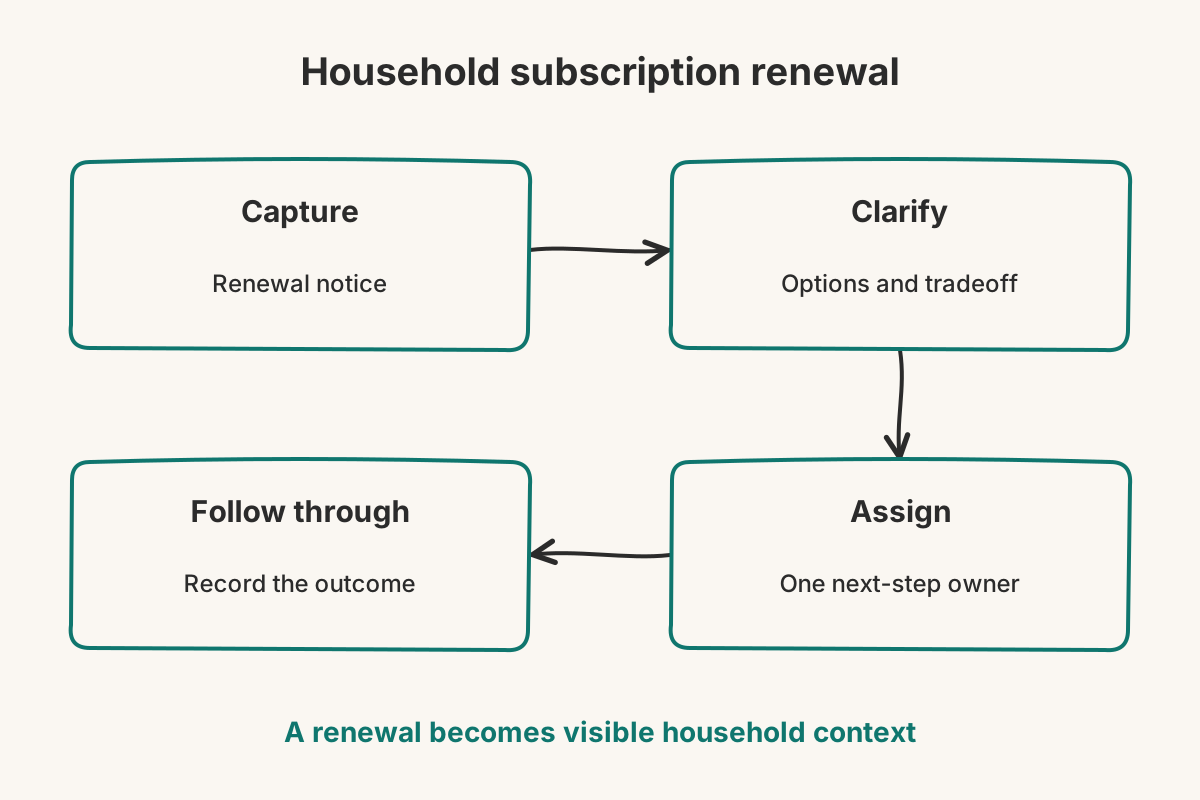
Move the card through Sivella's capture, clarify, assign, and follow-through loop. Capture the approaching renewal. Clarify the live routes and the fact that separates them. Assign that fact-finding or action to one person. Follow through until the household can record an outcome.
Ownership stays narrow. The person confirming the new price does not automatically become the household's permanent subscription manager. When the answer arrives, the next movement may belong to someone else: agreeing the tradeoff, making the change, or checking that the chosen route completed.
Ask one question at a time. “Do we keep this?” may still be too broad. “Would anyone lose something they use each week?” or “Which goal would this next period reduce?” can reveal the condition that settles it. The checklist should shorten the decision, not preserve every opinion voiced along the way.
What proves the renewal review is finished?
A conversation is not an outcome. Finish the card with one of four plain states: continued, changed, ended, or waiting until a named decision point. Add the date and the check that confirms the state. If further work remains, turn it into a distinct action rather than leaving the whole review open.
Bring the budget view into line with the result. A continued or changed commitment belongs among upcoming spending at its current expectation. An ended commitment should stop influencing later tradeoffs once the outcome is confirmed. The record then describes what the household now expects, not what it considered last week.
Sivella's Today plan shows what needs attention and the next step. It can surface the live enquiry or completion check while later renewals stay outside today's view. The checklist has done its job when another household member can understand the approaching commitment, the reason behind the choice, and the one movement still required without asking for a private recap.