Blog · Template
A shared household bills checklist with clear owners
A shared household bills checklist should show each upcoming payment, its due date, current status, and the person handling the next step. Keep recurring payments in the household rhythm, separate exceptions from the normal cycle, and record the outcome where everyone can see it instead of relying on one person to remember what has been paid.

A shared household bills checklist should show each upcoming payment, its due date, current status, and the person handling the next step. Keep recurring payments in the household rhythm, separate exceptions from the normal cycle, and record the outcome where everyone can see it instead of relying on one person to remember what has been paid.
Treat it as a handover sheet, not an account statement. Its purpose is to let a second person understand which commitments are routine, which have changed, and where intervention is needed. Banking credentials and card details belong somewhere more secure.
Which payments belong on the household bills checklist?
Include commitments whose timing or amount affects other people at home: rent, utilities, insurance, internet, service contracts, and subscriptions paid from household money. Exclude personal purchases that do not alter a shared plan.
Give each entry the same eight fields:
- Commitment: the recognizable provider or purpose.
- Cycle: monthly, quarterly, annual, or one-time.
- Due point: the actual date or payment window.
- Figure: confirmed amount or clearly marked estimate.
- Route: automatic, manual, or awaiting setup.
- State: expected, ready, queried, or settled.
- Payer: the person handling this cycle.
- Result: what happened, including any unresolved difference.
A label such as “electricity” is too thin. “Electricity, quarterly, amount not final, statement due on the 12th, Imani checking” tells another resident exactly where the matter stands.
Sivella's budget ledger tracks goals, upcoming spending, and tradeoffs. Add the expected payment there when it may affect another commitment. The checklist then carries the small administrative facts needed to move it.
How should fixed, variable, and automatic bills differ?
A fixed bill can usually keep one figure until the provider changes it. A variable bill needs a fresh amount each cycle. An automatic payment needs visibility even when nobody presses a payment button, because the debit still reduces what the household can use elsewhere.
Use a simple notation rather than treating every entry alike:
- Fixed: check the next due date and watch for a notice of change.
- Variable: replace the estimate when the statement arrives.
- Automatic: record the expected debit and inspect only when it differs.
- Manual: name the payer for this cycle and mark the result afterward.
This page does not assume a bank feed or transaction import. Sivella is verified as holding budget context; automatic banking behavior is not established. Enter the known commitment without claiming that the product can discover or reconcile it.
What happens when a normal bill becomes an exception?
Keep the baseline intact and open a temporary action. A disputed charge, revised renewal, failed debit, promised credit, or missing statement should not overwrite the ordinary cycle before the outcome is known.
Sivella supports recurring reminders and one-off nudges. Let recurrence bring back the regular check. Use a one-off nudge for the exception: ask for the corrected invoice, confirm a new tariff, or look for the credit after its promised date. Close that nudge when the result arrives.
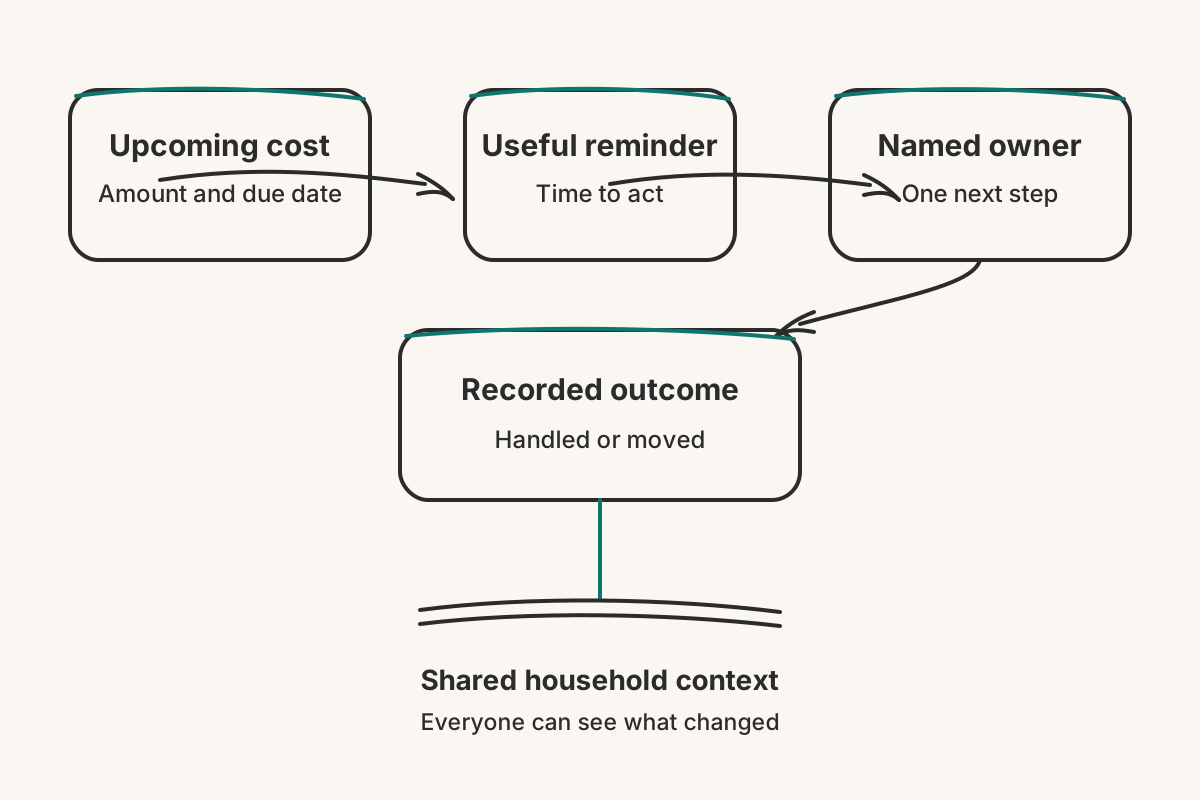
Name one person for the live enquiry. Sivella tasks carry an owner, which makes the handoff explicit without assigning that person every future payment from the same provider. The payer can change next cycle; the checklist preserves continuity.
How does another household member take over?
Read the entry in this order: due point, figure, state, payer, result. If any field requires oral history, repair that field before transferring it. “Called them” is activity, not a result. “Corrected statement promised by Friday” gives the next reader a date and an expectation.
Sivella's working loop is capture, clarify, assign, and follow through. For bills, that means recording the commitment, distinguishing routine from exception, naming the current payer, and keeping the item open until its state is settled or deliberately parked.
Finish with a brief scan of payments whose due point falls before the next household review. Check that every variable amount is labeled, every exception has one payer, and every completed action has an outcome. Sivella's Today plan can surface what needs attention now while later cycles remain out of the way.
The checklist has done its work when a housemate can take over one payment without borrowing the original organizer's memory. The money still needs care; the knowledge of how it stands is no longer private.