Blog · Use case
A household budget for shared spending decisions
A household budget can guide shared spending decisions when goals, upcoming costs, and tradeoffs sit beside the options being considered. Sivella keeps that budget context with decisions, constraints, and ownership, so everyone can see what a choice would displace and who will move the next step.

A household budget can guide shared spending decisions when goals, upcoming costs, and tradeoffs sit beside the options being considered. Sivella keeps that budget context with decisions, constraints, and ownership, so everyone can see what a choice would displace and who will move the next step.
Imagine the washing machine has started making an expensive noise. The household could repair it, replace it, or wait. None of those routes can be judged from the appliance alone. An insurance renewal is approaching, money is being set aside for a trip, and waiting carries its own risk. The choice becomes clearer when those pressures appear in the same view.
Which budget facts matter before a household purchase?
Look forward before looking backward. The useful facts are the ones that can alter the purchase: a goal the household is protecting, spending that is already approaching, and the tradeoff created by adding something new.
Sivella's budget ledger tracks those three things—goals, upcoming spending, and tradeoffs. That is different from asking one person for a remembered balance. Everyone can look at what the near future already contains before a new commitment is added to it.
An amount does not need to be final to matter. A confirmed renewal and a rough repair estimate carry different certainty, but both affect what feels sensible now. Mark the distinction in ordinary language. The point is not false precision; it is making sure an expected cost does not vanish merely because the invoice has not arrived.
What changes when two household costs overlap?
An overlap creates a timing question before it creates a yes-or-no answer. Replacing the machine this week might delay the trip goal. Repairing it might preserve that goal but leave another replacement likely later. Waiting until after the renewal might protect cash now while accepting inconvenience.
This is where a tradeoff becomes useful. It names both sides of the move. Instead of “that costs too much,” the household can see “doing this now postpones that goal” or “waiting leaves this risk open for another month.” The conversation stays about consequences rather than about who is allowed to spend.
Keep the budget as context, not as a verdict delivered by its usual keeper. Sivella holds money beside the wider household record so the people affected by the choice can begin from the same pressures. Nobody has to reconstruct the coming month from memory before the discussion can start.
How does money shape the shared decision?
Once the financial pressure is visible, return to the practical routes. Sivella's decision area keeps options, constraints, and ownership together. For the noisy washing machine, the relevant picture could be three simple possibilities: a repair before the renewal, a replacement after it, or another month of waiting while the trip fund stays untouched.
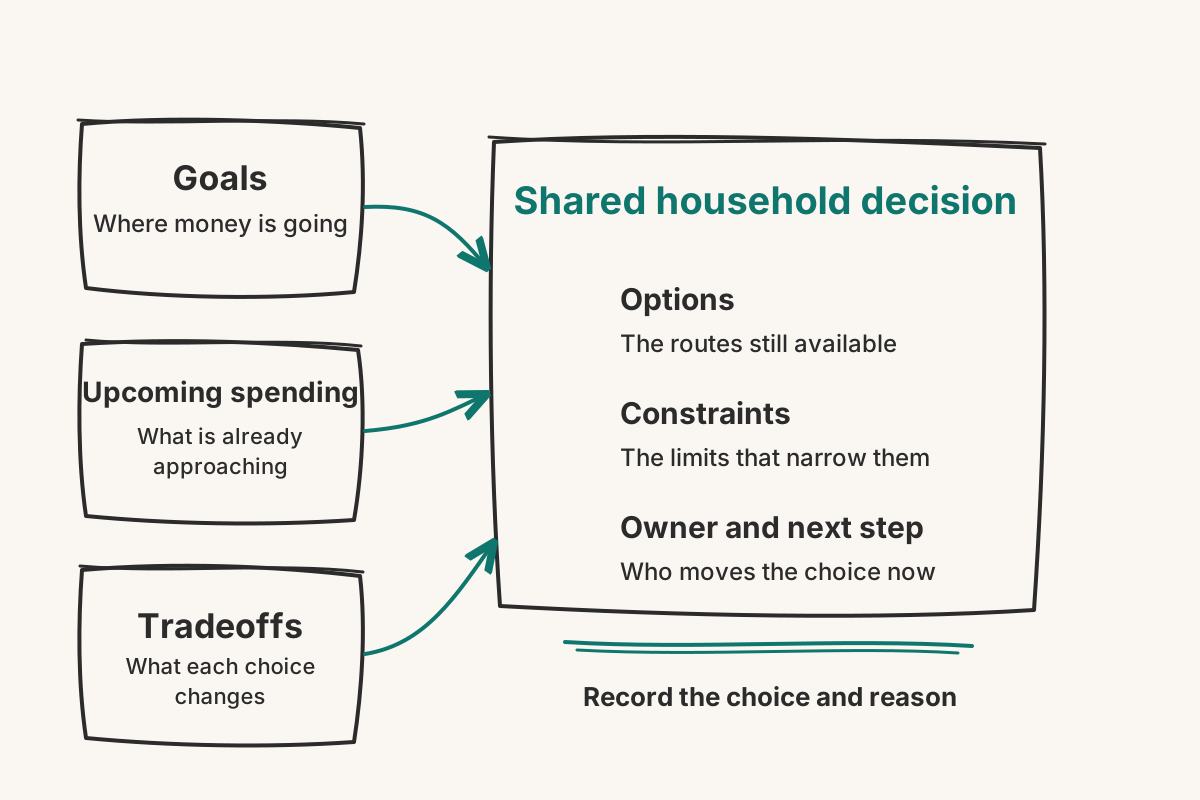
Now the numbers have a job. They show which route fits the month instead of producing a general feeling that the purchase is either affordable or irresponsible. Timing and availability can sit beside the financial limit, because a cheaper route is not useful if nobody can arrange it or if it arrives too late.
Choose the one unknown that keeps the routes from being compared. Someone can confirm the repair quote, check the renewal date, or find the delivered cost of a replacement. Sivella tasks carry an owner, so that enquiry does not drift back to the person who first heard the noise. The assignment can end when the answer arrives.
What happens once the household agrees?
Translate the agreement into the two places it now affects. Keep the expected amount among upcoming spending while it still belongs in the household's forward view. Put the practical movement—booking the repair, placing the order, or checking again on a named date—into an owned task.
Sivella's Today plan shows what needs attention and the next step. That means the financial conversation can finish without the action disappearing after it. The budget continues to show the pressure; Today presents the movement when it needs somebody.
This follows Sivella's capture, clarify, assign, and follow-through loop in a concrete way. The household catches the possible cost, works out what it changes, names the person making the next enquiry, and carries that movement through rather than reopening the money conversation from the beginning.
The budget has done its job when it helps the household understand a consequence, not when it stops every purchase. Goals, approaching costs, and choices remain connected. The home can act without appointing one person to remember the numbers, explain the compromise, and chase the booking.