Blog · Template
A shared household laundry schedule with clear handoffs
A shared household laundry schedule should show what is ready, which stage comes next, and who owns that movement. Separate collecting, washing, drying, and returning clothes so a finished machine cycle is not mistaken for a finished job. Use recurring reminders for stable rhythms and one-off actions for exceptions.

A shared household laundry schedule should show what is ready, which stage comes next, and who owns that movement. Separate collecting, washing, drying, and returning clothes so a finished machine cycle is not mistaken for a finished job. Use recurring reminders for stable rhythms and one-off actions for exceptions.
Laundry is a chain disguised as a chore. Somebody notices a load, somebody starts it, and later there is still damp fabric, an occupied rack, or a folded stack waiting to return. A schedule becomes useful when it describes those handoffs rather than merely choosing a washing day.
When is a shared laundry load ready to begin?
Include laundry that several people rely on or deliberately combine: towels, bedding, kitchen cloths, or a mixed load the household has agreed to wash together. A private basket can remain outside the shared routine when its timing has no effect on anybody else.
Choose a trigger that can be recognized without a reminder from another person. It may be a full towel basket, the morning after bedding comes off, or the last clean kitchen cloth entering use. A weekday alone can work for a stable rhythm, but it should not force a half-empty load simply to satisfy the calendar.
Use one short line for each shared load:
- Load: what travels through the cycle together.
- Ready when: the visible condition or useful day.
- State: Ready to wash, Washed, Dry, or Returned.
- Next owner: the person moving it one stage.
- Needed by: only when a real household plan sets a boundary.
- Changed route: the temporary fact that makes this cycle different.
The state is more important than a detailed washing record. Another person needs to know where to continue, not every minute the load spent in the machine.
Where does one person's part of the laundry end?
Give each handoff its own finish line. The washing step ends with the load clearly marked Washed and ready for drying. Drying ends at Dry, after the fabric is actually ready to fold or hang away. The cycle closes at Returned, when shared items are back in the cupboard, bathroom, or bed where the household expects them.
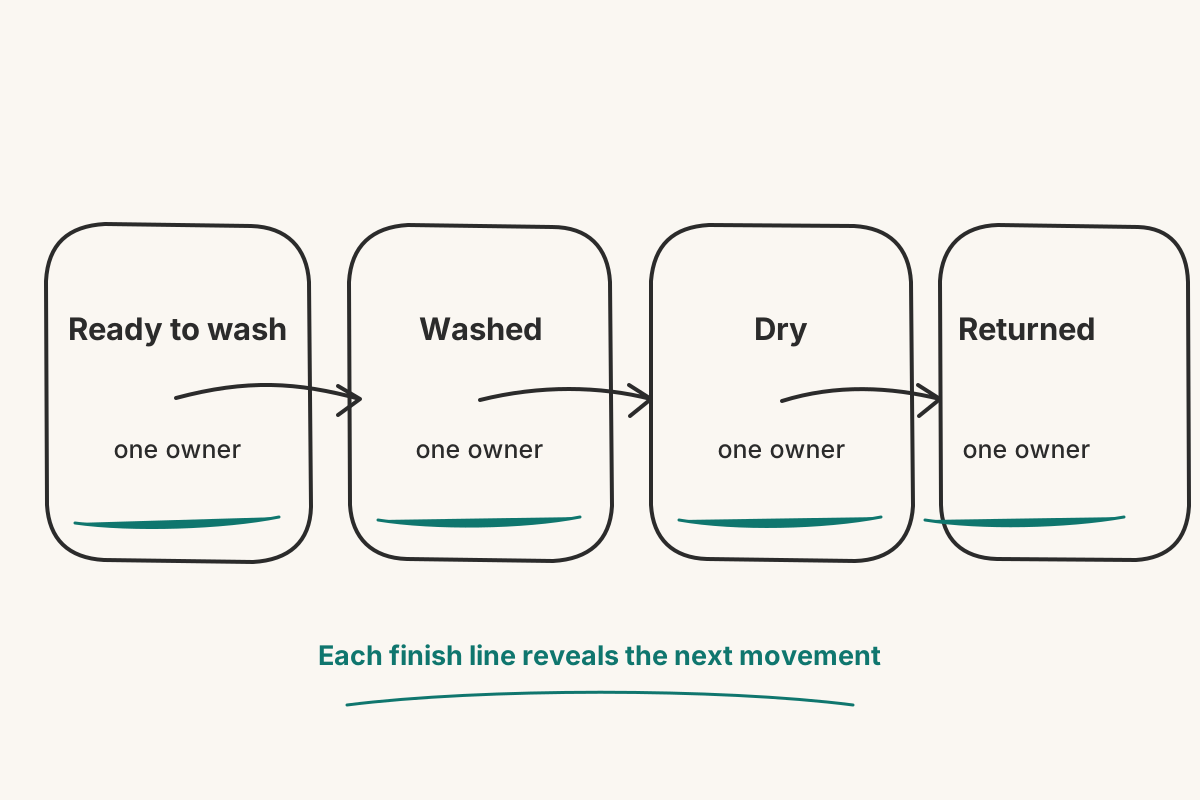
Sivella tasks carry an owner. That owner can be attached to the next movement instead of to “laundry” forever. One person may wash this load, another may take it from the rack, and either can see whether the baton has moved without asking for a recap.
Do not mark a stage from memory before it is true. A machine that has stopped contains wet laundry, not a completed household job. Equally, a folded stack left on the bench has not reached Returned. Precise states make unfinished work visible without turning it into a complaint.
Should the schedule follow days or changing conditions?
Reserve a repeating rhythm for loads whose return is predictable enough to benefit from one. Sivella reminders cover recurring rhythms, so a bedding change or a regular towel review can come back without someone privately holding the interval.
Exceptions deserve their own temporary action. Guests may create another bedding cycle. Rain may change where a load can dry. A person leaving early may need to pass the next stage before the usual time. Sivella also provides one-off nudges; close one after the altered cycle rejoins the normal routine.
Timing should describe a consequence, not manufacture pressure. Bedding needed that evening has a boundary. Towels that can wait until tomorrow do not become urgent because the basket is visible. Record the honest next point and let the rest of the household plan stay quiet.
What stops the laundry plan becoming supervision?
Nobody should have to inspect the whole chain on another person's behalf. If the same resident keeps checking the basket, listening for the machine, or asking whether dry items were put away, look for the missing handoff. The trigger may be vague, the state may stop at “started,” or one person's ownership may cover too much of the cycle.
Use Sivella's Today plan only for the stage that now needs attention. Today is a single view of what needs attention and the next step, so the full weekly laundry rhythm can remain in the background until a load reaches a live movement.
Review the arrangement after a few ordinary cycles. Keep the triggers people can genuinely see. Shorten assignments that still require monitoring. Remove reminders that add noise without changing action. The routine is shared when any household member can identify the current state, take the next stage, and close the load without borrowing somebody else's memory.