Blog · Template
A shared car maintenance checklist for the household
A shared car maintenance checklist should show each vehicle’s next service, current issue, appointment, likely cost, and owner. Keep routine maintenance on recurring reminders, turn unexpected problems into separate actions, and record the result so every driver can see what happened and what comes next.
A shared car maintenance checklist should show each vehicle’s next service, current issue, appointment, likely cost, and owner. Keep routine maintenance on recurring reminders, turn unexpected problems into separate actions, and record the result so every driver can see what happened and what comes next.
This is a coordination checklist, not a universal service schedule. Use the intervals and instructions that apply to the particular vehicle. The household record answers a different question: who has noticed, booked, paid attention to, or followed up each piece of work?
What belongs on a shared car maintenance checklist?
Give each vehicle its own short record. A household with more than one car should not have to infer which set of keys a reminder belongs to. Start with information another driver needs in order to continue the work:
- Vehicle: the plain name everyone at home uses.
- Routine item: the service or inspection that returns.
- Due point: the date, mileage, warning, or other applicable cue.
- Current state: upcoming, ready to book, booked, waiting, or complete.
- Owner: the person moving the immediate next step.
- Appointment: the confirmed date and access arrangement, if there is one.
- Expected cost: a confirmed amount or a clearly marked estimate.
- Result: what was done, what remains, and the next due point.
Copy the next service cue from the vehicle's handbook or the workshop's written advice. Record its source beside the date or mileage. If two drivers use the car, choose who reads the odometer and updates the entry; a date alone will miss a mileage limit reached early. Follow the vehicle's own guidance and use appropriate professional advice for work beyond the household's knowledge or safe reach.
How should routine service and unexpected issues differ?
Put predictable work on the rhythm that genuinely applies to it. Sivella reminders cover recurring rhythms as well as one-off nudges. A recurring reminder can bring the next routine check back without somebody privately keeping the date.
Treat a new noise, warning, failed part, or changed appointment as a separate item. It may produce one call, a quote to consider, or a decision between available routes. Do not overwrite the ordinary service rhythm with a temporary problem and then rely on somebody to restore it later.
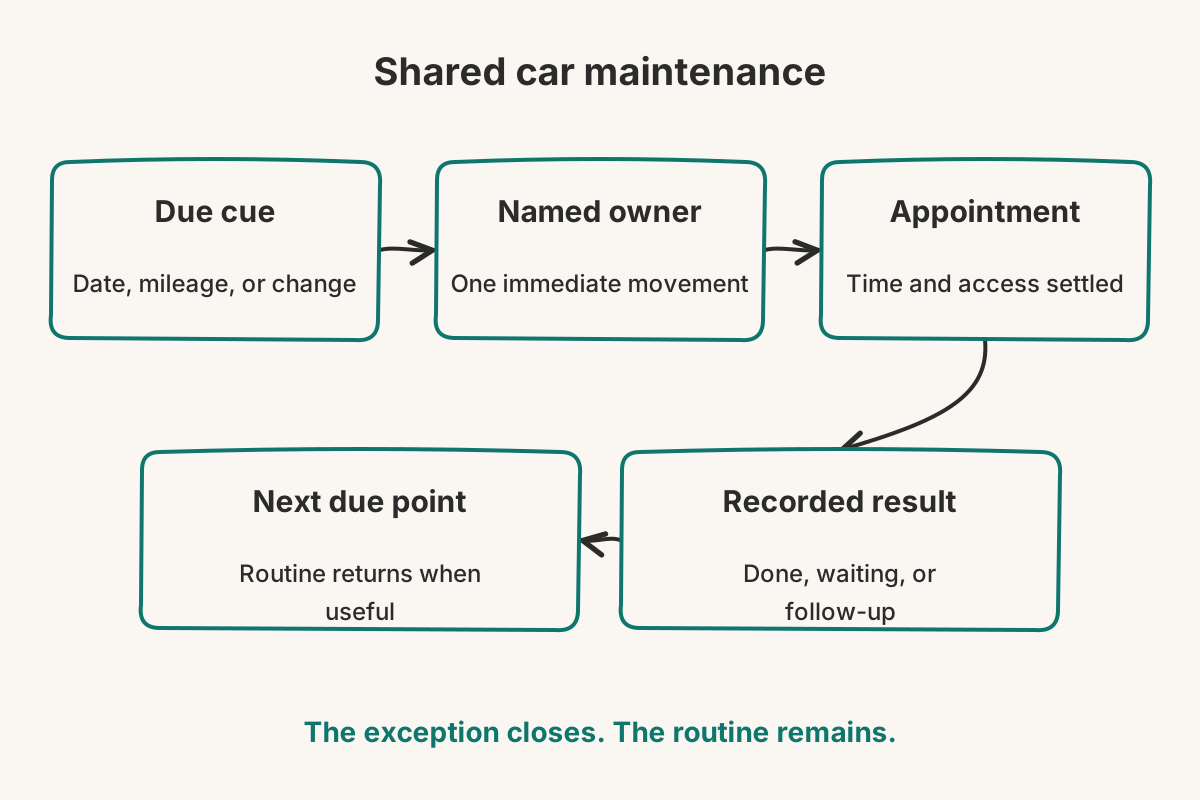
This separation keeps the normal schedule stable while the exception moves through Sivella’s capture, clarify, assign, and follow-through loop. Capture what changed, clarify the next useful action, assign that action, and keep it visible until there is a result or an intentional decision to pause.
Who owns the next car maintenance step?
Separate the booking from the transport. Name the person calling the garage, the driver taking the car in, and the person collecting it. Sivella tasks carry an owner, so those can be three small assignments. Write down which key goes with the car and where the spare remains. If the car will stay overnight, settle how its usual drivers will travel before accepting the slot.
Compare the garage's drop-off and collection hours with the drivers' availability. Sivella shares free-or-busy calendar availability without exposing event details. A free morning may solve drop-off while leaving collection unresolved; check both journeys rather than treating the service as one appointment everyone can forget until evening.
Before handing over the keys, agree who receives the garage's estimate and who answers a request for additional work. Keep the estimate beside upcoming spending in Sivella's budget ledger. Its decision area holds options, constraints, and ownership when the household needs to compare the garage's proposals. A booking confirms a visit; it should not leave the driver at the counter guessing what spending the household has agreed.
What should be recorded after the appointment?
Read the invoice or service report before filing it. Note the work completed, the mileage at the visit, and the workshop's next service instruction. Separate an advisory item from a completed repair. If a part is on order, keep its reference and the promised update point with the person checking back. The driver collecting the car should leave enough information for someone else to make that call.
Check the routine reminder against the new date or mileage, then close the one-off booking and collection actions. Return keys and any removed accessories to their usual places. Tell the other drivers whether the car is back, still at the garage, or awaiting an agreed next visit. Keep the workshop's instructions in its own words rather than turning a household note into mechanical advice.
Sivella’s Today plan can then show the car-related work that needs attention now while later maintenance stays quiet. The checklist is working when any driver in the household can answer five questions without finding the usual coordinator: what is due, what changed, who owns the next step, when the appointment is, and what happened last time.