Blog · Template
How to request a Sivella data export
To request a Sivella data export, email [email protected] from the address associated with your account. State that you want an export, identify the account, and keep the reply with your records. Sivella handles export requests within 30 days. Ask about scope or format in the same message if either matters to you.

To request a Sivella data export, email [email protected] from the address associated with your account. State that you want an export, identify the account, and keep the reply with your records. Sivella handles export requests within 30 days. Ask about scope or format in the same message if either matters to you.
An export request is a way to obtain a copy, not a request to close the account. Keeping those intentions separate makes the message easier to process and leaves less room for an irreversible action to be misunderstood.
What should a Sivella data export request include?
A short message is enough. Give the team the information needed to identify the account and understand the action you want, without copying private household material into the email.
Include:
- the email address associated with the Sivella account;
- a direct sentence asking for a data export;
- any question you have about the scope or delivery format;
- a request for confirmation that the message was received.
You can copy this starting point:
Subject: Sivella data export request
Please send me an export of the data associated with my Sivella account. The account uses this email address. Please confirm receipt and let me know if you need any other information to identify the account.
Do not paste tasks, budget entries, calendar information, or household decisions into the message as proof. Begin with the account address. If the team needs another identifier, it can ask for one without making the first email a second copy of the household record.
Where do you send the request, and when should you follow up?
Send the request to [email protected]. Sivella publishes that address for both export and deletion requests and states that they are handled within 30 days.
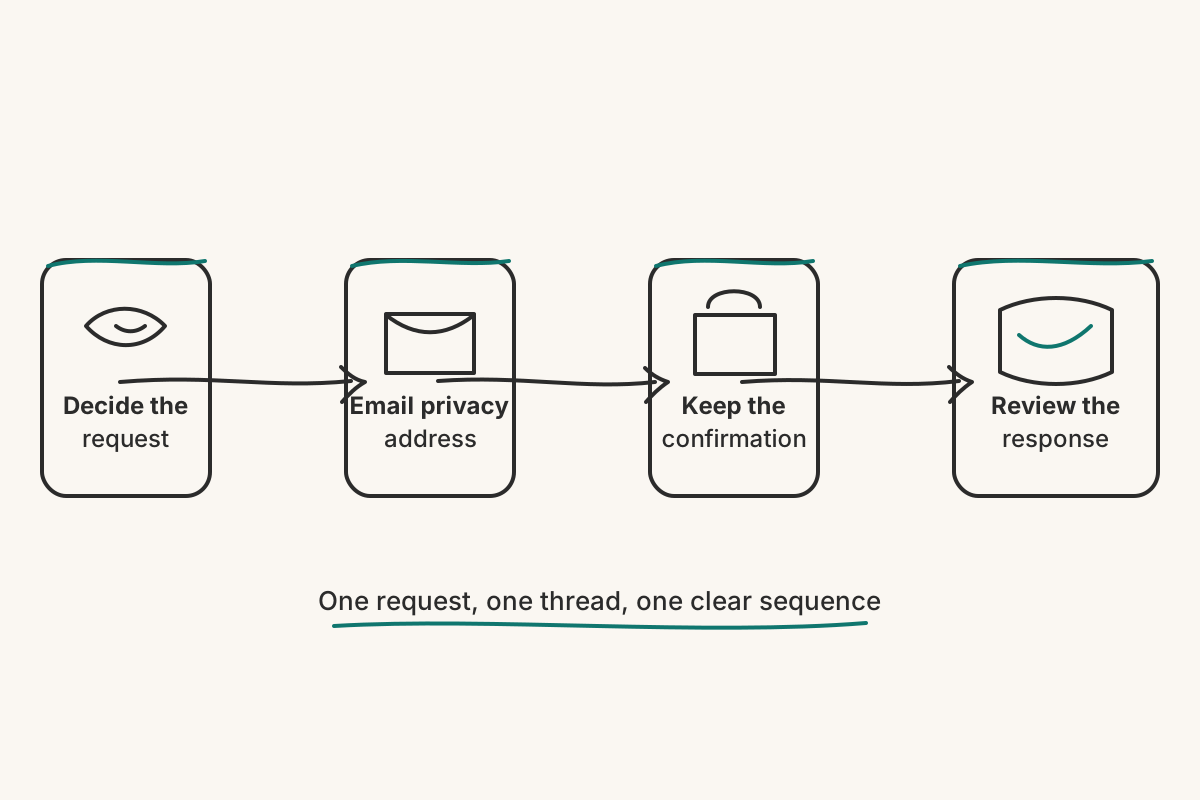
Save the sent message and any confirmation outside Sivella. They establish what you asked for and when you asked. If 30 days pass without the request being handled, reply to the original thread rather than starting a new one. That keeps the date and the earlier wording together.
The published product facts do not establish the archive's exact fields or file format. If you need the export for a particular purpose, ask before assuming it will arrive in a specific structure. A clear question in the original request is more useful than discovering after delivery that you expected something different.
What do you want the exported copy to help you do?
Name the purpose before you write. You might want an offline reference, a snapshot for your personal records, or material to review before changing how the household organizes its information. The reason need not go into the email, but it helps you recognize which questions matter.
If you expect to search the copy, ask what structure it uses. If you need it by a particular date, remember that the published handling window is 30 days and plan from that boundary. If your concern is whose information belongs in the copy, ask about scope directly rather than assuming that one member's request represents every private part of a shared household.
This small preparation turns “send me my data” into a request you can evaluate when the response arrives. You will know whether you received something usable for the purpose that prompted the request, and which follow-up question remains if you did not.
Do you need an export to correct one stored detail?
Not necessarily. Sivella lets a member inspect, edit, or remove what it has stored. If your goal is to correct stale household memory or remove one inaccurate item while continuing to use the account, use that smaller control instead of treating every correction as a full data request.
An export serves a different purpose: keeping a copy outside the product or reviewing the account information as a set. A correction changes the shared context the household continues to use. Decide which outcome you need before writing.
Sivella states that household data is never used to train, fine-tune, or improve an AI model, and is never sold or shared for advertising. Those commitments describe how the service handles the record. The export route adds a practical way to ask for your own copy of it.
The process is deliberately plain: decide what you need, write to the published privacy address, keep the confirmation, and review the response against the request you made.