Blog · Template
One-off household reminder examples that end with the work
One-off household reminders work best for a single action tied to a real event: confirm a delivery window, chase a repair quote, collect a refill, or revisit a choice. Write the next action, its useful timing, and its owner, then close the reminder when the outcome is recorded so temporary work does not become permanent noise.
One-off household reminders work best for a single action tied to a real event: confirm a delivery window, chase a repair quote, collect a refill, or revisit a choice. Write the next action, its useful timing, and its owner, then close the reminder when the outcome is recorded so temporary work does not become permanent noise.
A one-time nudge is not a smaller recurring routine. It has a reason to appear and a clear point at which it should stop. That makes it useful for the uneven work of a home: the loose end after a call, the check that depends on a date, or the choice that needs to return when new information arrives.
What counts as a one-off household reminder?
Use one when an action should surface once because a particular condition is true. The reminder may be tied to a date, an appointment, a promised reply, or the arrival of information. Its defining feature is not urgency. It is that completing or dismissing the action ends the need.
Common examples include:
- Repair follow-up: ask for the quote if it has not arrived by Thursday.
- Delivery check: confirm who can be home when the window is known.
- Refill collection: collect an item after the service says it is ready.
- Decision return: review the appliance choice when the second estimate arrives.
- Home handoff: check that the agreed access arrangement is complete before leaving.
Sivella supports one-off nudges as well as reminders for recurring rhythms. Keep the distinction plain: a filter change that genuinely returns on a stable interval may recur; chasing one missing reply should end after the reply is handled.
What should a one-time household reminder say?
Write the reminder as the next observable action, not as the subject causing concern. “Call about the repair quote” gives someone a move. “Bathroom leak” leaves them to reconstruct the conversation before acting.
Use this copyable structure:
- Action: one verb and the thing it moves.
- Timing: the date, window, or event that makes the action useful.
- Owner: the person responsible for this movement.
- Context: only the constraint or prior result needed to act.
- Outcome: what should be recorded before the reminder closes.
For example: “Confirm the Friday delivery window after the supplier replies. Jordan owns the confirmation. Record who will be home, then close this reminder.” The useful context travels with the action, but the reminder does not become a transcript.
Sivella tasks carry an owner. That makes the immediate responsibility visible without making one person the permanent owner of the whole repair, purchase, or appointment.
When should the reminder recur instead?
Ask whether the same completed action should return on a dependable rhythm. If yes, recurrence preserves the schedule. If no, keep it one-off and let it finish.
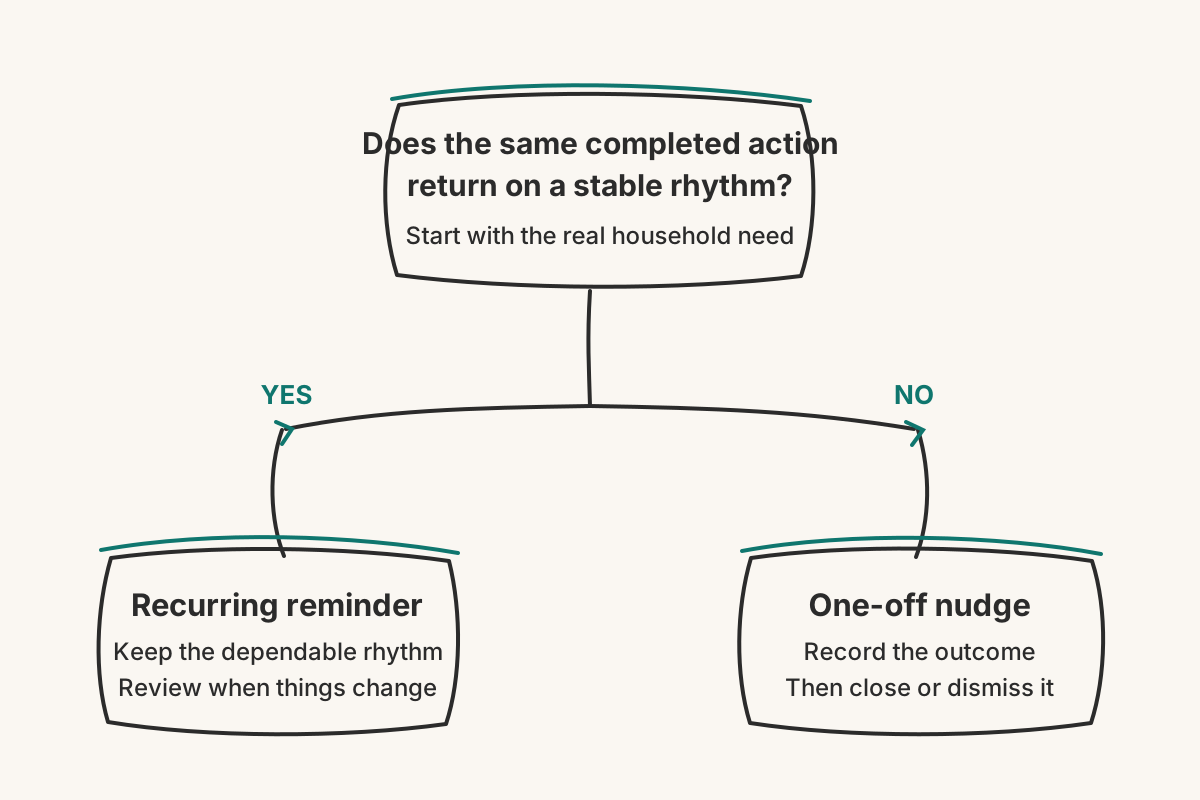
A monthly meter check may recur. A check on a disputed reading should not. A seasonal service may recur. A call to confirm this year's appointment should end when the appointment is settled. Separating the baseline rhythm from its exceptions keeps a temporary problem from rewriting the household's normal routine.
Use timing that reflects a real boundary rather than adding urgency. A promised callback date, the last day an option remains open, or a confirmed collection window gives the reminder a reason to appear. “Soon” simply hands the timing decision back to whoever already carries it.
How do you close temporary household work cleanly?
Close the reminder when there is an outcome, not merely when activity happened. “Called” may still leave the household waiting. “Quote due Monday; Priya will review it” records the new state and gives the next movement an owner.
Sivella's working loop is capture, clarify, assign, and follow through. A passing concern is captured, the one-time action is clarified, one person owns it, and the item stays present until it is resolved or intentionally dismissed. Sivella's Today plan can then show what needs attention and the next step without displaying every future household rhythm at once.
Before closing, ask three questions: What changed? Does anything new need an owner? Can the old nudge now disappear? If the answer to the last question is no, replace it with the newly clarified action rather than keeping a vague reminder alive.
A calm reminder earns its place by reducing remembering between people. It appears when the household can act, carries enough context for someone else to move it, and leaves once its work is done.