Blog · Template
A household chores checklist for when someone is away
When someone is away, keep the household's usual rhythms visible, assign only the temporary cover their absence creates, and name when each responsibility returns. A short checklist for due work, changed availability, owners, and a return point prevents a brief absence from becoming one person's new permanent workload.

When someone is away, keep the household's usual rhythms visible, assign only the temporary cover their absence creates, and name when each responsibility returns. A short checklist for due work, changed availability, owners, and a return point prevents a brief absence from becoming one person's new permanent workload.
Think in terms of a coverage window, not a complete transfer. The window begins when the person becomes unavailable and ends when the normal arrangement can reasonably restart. Only work with a consequence inside that window needs a substitute. Everything else can remain untouched, wait for the person who usually handles it, or be dropped after an explicit choice.
Which chores cross the coverage window?
Write the departure and return points first. Then look at what will actually come due between them. This prevents the checklist from becoming an inventory of the absent person's contribution to the home.
Sort each possible item into one of these outcomes:
- Cover now: delay would affect another person, miss an outside deadline, or create avoidable trouble.
- Move past the window: the work matters, but not before the household is together again.
- Leave with its usual owner: preparation can happen before departure or follow-up can happen after return.
- Dismiss: the item no longer earns a place merely because it was once planned.
The useful list may be surprisingly short. A bin collection, a delivery slot, a refill, and one promised callback can matter more than a page of general cleaning. Name the occurrence rather than the whole category. “Thursday bin collection” asks for temporary cover; “waste and recycling” sounds like a department somebody must inherit.
Sivella can hold repeating reminders and single nudges. Keep the repeating reminder as the household's baseline, then use a single nudge for an unusual check or handoff caused by this absence. The exception should be visibly finite.
Who can realistically cover each live action?
Do not copy every item from one name to another. Match each action to the person who can perform it during the relevant window. A person may have room for an evening refill but not for a daytime service visit. Another may be available for the visit but not know which question still needs answering.
Check four fields for each live action:
- Trigger: the date or event that brings it into view.
- Move: the smallest observable action required this time.
- Covering owner: the person responsible for making that move.
- Close: the result the rest of the household should be able to see.
Sivella tasks carry an owner. Use that name for the present move rather than as a permanent reassignment. “Noah receives the parcel on Wednesday” is clear. “Noah handles deliveries now” quietly changes the household without a decision.
When presence at home matters, compare availability before assigning the action. Sivella syncs free-or-busy availability from Google, Outlook, iCloud, and CalDAV; event details are not exposed. The household can identify a workable window without making the private reason behind a blocked hour part of the checklist.
How does temporary cover return to normal?
Build the ending at the same time as the cover. Use this sequence: Usual rhythm, Temporary cover, Return point, Usual ownership resumes. The return point is not necessarily the moment a suitcase comes through the door. It is the first sensible moment to close the exception and restore the baseline.
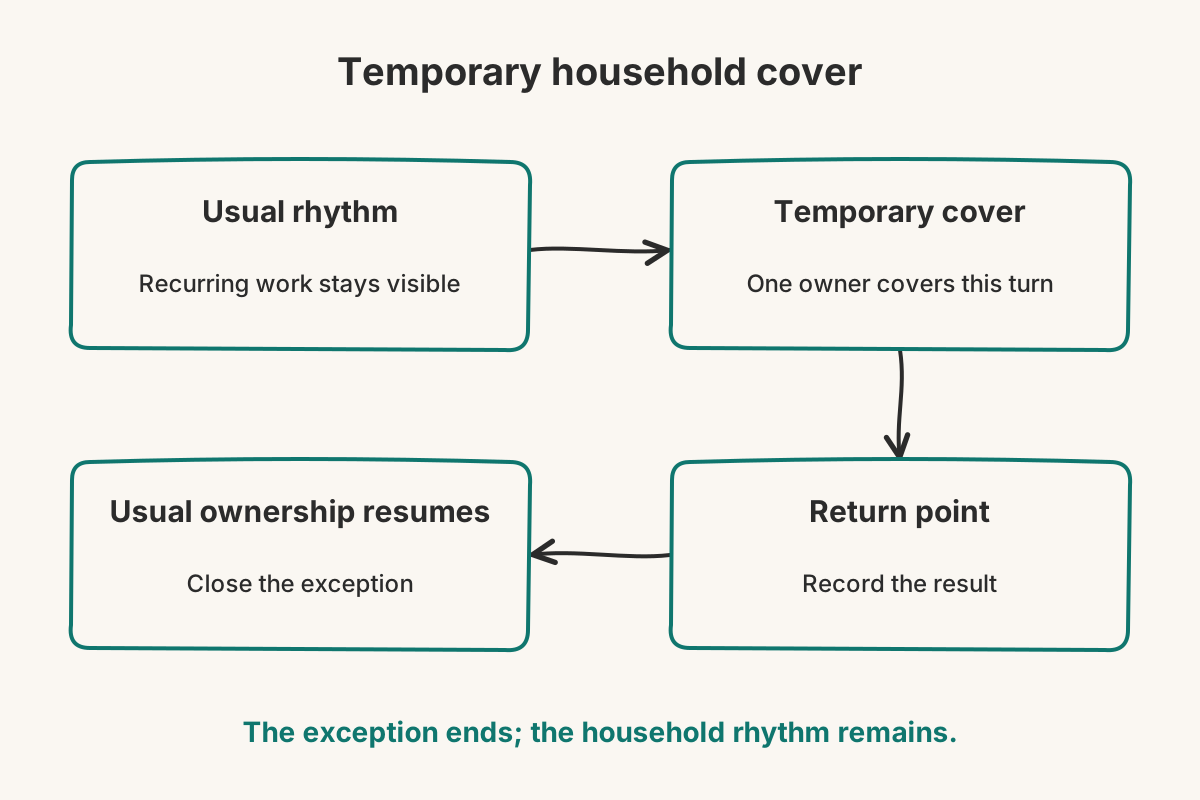
Choose one concrete return point for each unusual arrangement: the next collection day, the first weekly shop after the trip, or a quick review once the outstanding reply arrives. At that point, record anything that changed the future. Perhaps the supplier could not fill the order, the appointment produced another visit, or the old rhythm proved unnecessary.
Avoid a long debrief. A useful outcome is enough: finished, moved to a named date, turned into a new owned action, or deliberately abandoned. Sivella's capture, clarify, assign, and follow-through loop gives each new fact somewhere to go without keeping the temporary cover open forever.
What belongs in the final before-leaving check?
Ask someone who did not make the list to read it. They should be able to see the boundaries of the absence, the few consequences being protected, and the person covering each next move. If they need a spoken history, add the missing operational fact rather than a longer narrative.
Run this final check:
- Mark the coverage window.
- Keep only work that crosses it.
- Give each live move one covering owner.
- State the result that closes the move.
- Add the point where the exception ends.
While the household is running with fewer people, Sivella's Today plan can narrow the shared record to what needs attention and the next step. Later work can remain outside the day's view. The checklist has done its job when nobody away must keep prompting from a distance, nobody at home inherits an unnamed bundle of work, and the ordinary arrangement has a clear way back.