Blog · Template
A household appointment coordination checklist
A household appointment coordination checklist should keep the reason for the visit, workable times, booking owner, preparation, attendance, and follow-up visible in one place. Separate private details from the operational facts the household needs, and give each next action one owner so an appointment does not become one person's chain of reminders.

A household appointment coordination checklist should keep the reason for the visit, workable times, booking owner, preparation, attendance, and follow-up visible in one place. Separate private details from the operational facts the household needs, and give each next action one owner so an appointment does not become one person's chain of reminders.
Use this structure for appointments that affect more than one person: a home service visit, an appointment one person needs help reaching, or a booking whose timing changes the household plan. The checklist coordinates the shared work around the appointment. It does not require personal details that nobody else needs in order to help.
What should you record before booking an appointment?
Begin with the operational facts. Write the purpose in terms the household recognizes, the range of acceptable dates, the place or format, and the person responsible for making the booking. If the appointment depends on a referral, quote, confirmation, or other missing information, make that dependency its own next step.
Copy these fields:
- Purpose: enough to identify the appointment without adding a private history.
- Timing boundary: the date, window, or event that limits the choice.
- Location or format: where somebody needs to be, or whether the appointment is remote.
- Booking owner: the person making the enquiry or confirmation.
- Missing fact: the one answer needed before booking can finish.
- Booked result: the confirmed time and any immediate preparation.
Sivella tasks carry an owner. Keep that ownership narrow: making the call does not automatically make the same person responsible for transport, attendance, and every later follow-up.
How do you find a workable time without sharing private calendars?
Start with availability, not explanations. The household usually needs to know whether a person is free for a proposed window, not why another hour is blocked.
Sivella syncs free-or-busy availability from Google, Outlook, iCloud, and CalDAV and never exposes event details. That lets household members compare workable windows while personal appointments and work commitments keep their own names and descriptions elsewhere.
If several people need to be available, record the chosen window only after everyone required for the handoff is free. Then name who will attend, who will cover another household commitment if needed, and who needs the confirmed time. A visible result prevents the booking owner from becoming the person who must repeat the update separately to everyone.
What preparation and handoff does the appointment need?
Treat preparation as a short chain of actions, not as one instruction to “get ready.” The chain may include confirming access, gathering an item already requested, arranging transport, or making sure the right person is present. Use only the steps this appointment actually requires.
Give each step an observable finish line and one owner. Sivella supports one-off nudges, which fit temporary actions such as confirming a window or checking for a promised reply. Close each nudge when the outcome arrives instead of allowing temporary appointment work to become a recurring reminder.
Keep private information proportionate. Sivella uses the same boundary for energy check-ins: the household sees the capacity level and date while a personal note stays private. For an appointment, share the timing and handoff facts people need, while leaving the private reason out when it does not change their action.
What should happen after the appointment?
Record the result before the details scatter. Choose one of four states: complete with no further action, waiting for information, another appointment needed, or a new household task created. “Appointment happened” is not a useful close if somebody still has to call, collect, decide, or book again.
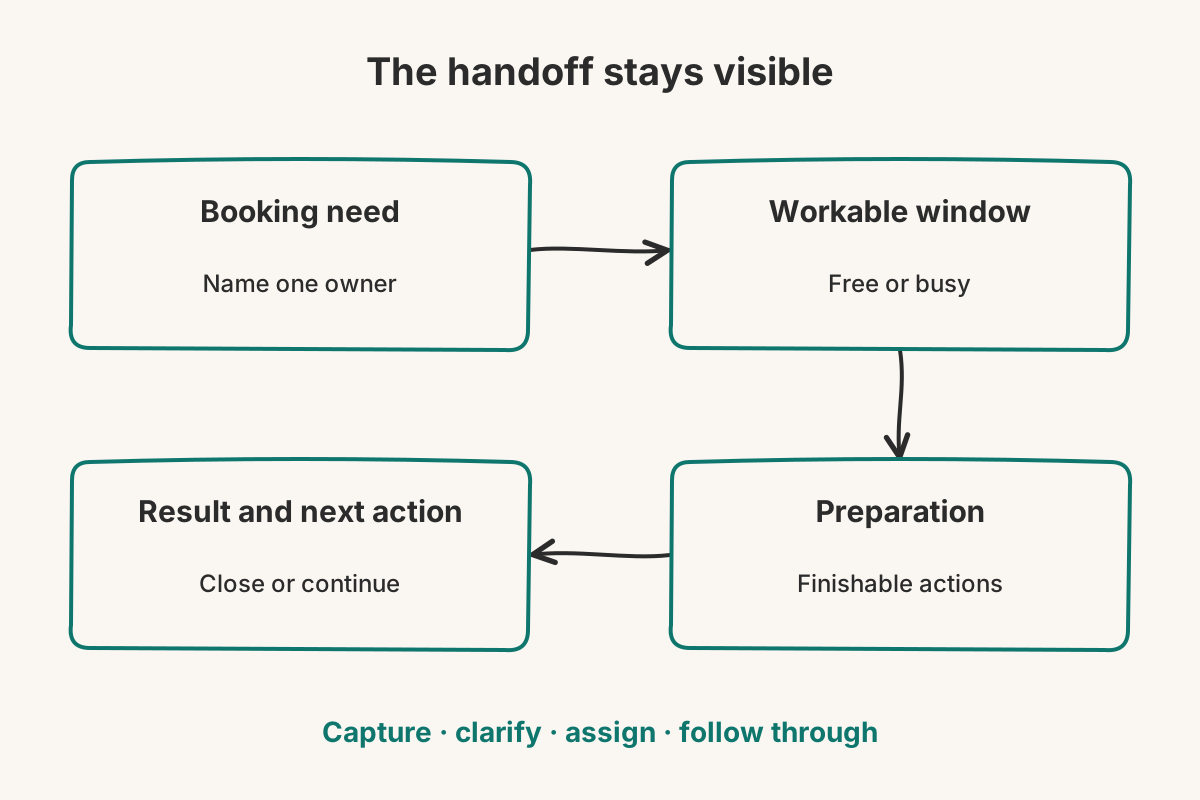
Sivella's working loop is capture, clarify, assign, and follow through. The appointment need is captured, the workable action is clarified, one person is assigned, and the item remains visible until there is a result or an intentional decision to stop.
Before closing the checklist, ask: What changed? Is there a new date or constraint? Does one person own the next movement? Can the old reminder disappear? Sivella's Today plan can surface the immediate next step while later appointment context waits out of the way.
The handoff is complete when another household member can see what was booked, what preparation remains, who is handling it, and what follows afterward without asking the original coordinator to reconstruct the sequence.