Blog · Template
A shared pet care schedule for the whole household
A shared pet care schedule should show what is due, who owns the next step, and what has already been handled. Put regular care on recurring reminders, keep exceptions as one-off actions, and reassign work when plans change. Sivella keeps those actions visible in shared household context instead of one person's memory.

A shared pet care schedule should show what is due, who owns the next step, and what has already been handled. Put regular care on recurring reminders, keep exceptions as one-off actions, and reassign work when plans change. Sivella keeps those actions visible in shared household context instead of one person's memory.
Pet care is easy to describe as a routine and surprisingly easy to duplicate or miss. One person leaves early, another assumes breakfast happened, and the question arrives after everyone has moved on. A useful schedule does more than name the routine. It makes each handoff legible.
What belongs on a shared pet care schedule?
Begin with care that another person may need to confirm or take over. Group it by rhythm rather than by whoever usually does it:
- Several times a day: meals, water checks, walks, or habitat checks.
- Weekly: grooming, cleaning bedding, washing bowls, or restocking supplies.
- Occasional: appointments, collecting a refill, replacing equipment, or arranging care while the household is away.
Write the observable action, not a broad subject. “Check water and refill if needed” gives the next person a finish line. “Cat” or “dog jobs” leaves the thinking with whoever already understands the routine.
For medicine, feeding amounts, and other health-related care, copy the current instructions agreed with the relevant veterinary professional. Do not simplify a precise direction merely to make the list neater. The schedule coordinates who follows the instruction; it should not invent the instruction.
Sivella supports recurring reminders and one-off nudges. Use recurrence only where the care genuinely repeats. An appointment or temporary change should end when it is handled rather than becoming a permanent rhythm.
Who owns each pet care handoff?
Put one owner on the next action. Sivella tasks carry an owner, so the household can see who is expected to move a piece of work. That owner can change without changing the care itself.
Keep the assignment narrow. The person handling the morning walk does not automatically own the food order, the next appointment, and every evening afterward. Separate actions allow a household to divide the real workload rather than giving one person the entire subject of pet care.
Use the same four-part handoff each time:
- The routine or one-off need becomes due.
- One person owns the immediate action.
- The action is resolved or deliberately moved.
- The household can see what needs attention next.
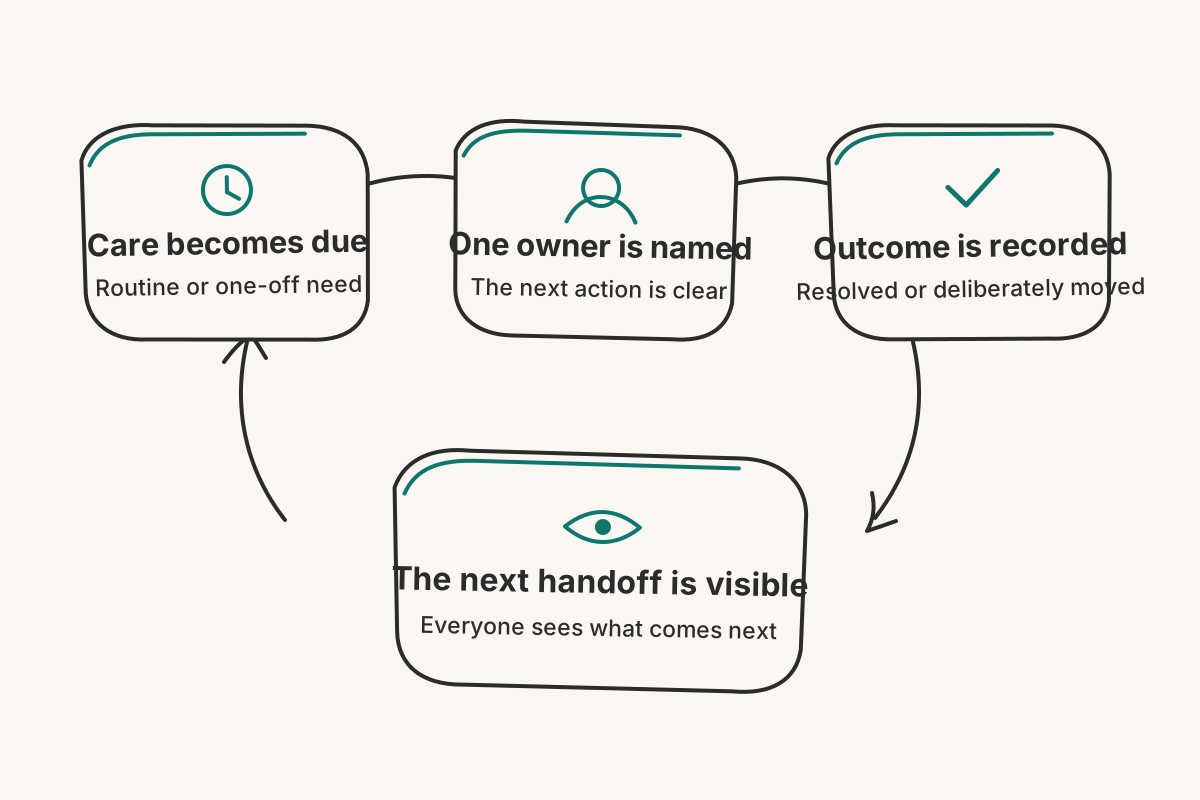
This follows Sivella's capture, clarify, assign, and follow-through loop. The point is not to document every moment. It is to leave enough context that another person can continue without asking for a recap.
What changes when the normal routine changes?
Treat an exception as new information, not as a failure of the schedule. If someone will be away, if an appointment changes the timing, or if a temporary instruction replaces the usual one, write the changed action and assign it directly.
Calendar availability can help with a handoff that needs someone at home. Sivella shares free-or-busy availability from Google, Outlook, iCloud, and CalDAV without exposing event details. The household can find a workable window without needing the private reason another time is blocked.
Do not edit the usual recurring item into a temporary instruction and then rely on somebody remembering to restore it. Keep the normal rhythm clear, add the exception as a one-off action, and close that exception when the household returns to normal.
How do you keep the schedule useful each day?
Use Sivella's Today plan for the care that needs attention now and its next step. The whole routine does not need to occupy everyone's attention all day. A daily view should surface what is due while longer rhythms wait quietly in the background.
Review the schedule when the same person repeatedly has to ask whether something happened. That question usually reveals one of three gaps: the action is vague, nobody owns it, or the outcome is not clear. Fix the gap rather than adding urgency.
A shared pet care schedule is working when any household member can answer three questions without finding the usual coordinator: what needs doing, who is handling it, and what changed today. The care remains ordinary. The remembering becomes shared.