Blog · Template
A low-energy household task triage checklist
A low-energy household task triage checklist protects fixed commitments, reduces optional work, assigns only the next necessary actions, and moves everything else without guilt. Sivella energy check-ins make capacity visible as low, steady, or high, so the household can reshape the workload without requiring anyone to share a private explanation.

A low-energy household task triage checklist protects fixed commitments, reduces optional work, assigns only the next necessary actions, and moves everything else without guilt. Sivella energy check-ins make capacity visible as low, steady, or high, so the household can reshape the workload without requiring anyone to share a private explanation.
Use this when the plan was reasonable yesterday and no longer fits today. The aim is not to rescue the entire list. It is to keep avoidable trouble from growing while making the day smaller on purpose.
Which household commitments still need protecting?
Begin with consequences, not with the order of the list. Protect work tied to an external time, another person's access, safety, food needed today, or a payment that cannot calmly move. Everything else must earn its place again.
Read each active item and ask: what changes if nobody does this today? Keep it when delay closes a real option or creates immediate work for somebody else. Move it when the answer is only that the list will look less complete.
Sivella's Today plan shows what needs attention and the next step. Use that narrow view rather than scanning every open household task. A fixed commitment may still need only one small movement: confirm the appointment, put the essential item on the shopping list, or tell another person that a handoff has changed.
What can become smaller, later, or deliberately dropped?
Give every remaining item one of three outcomes:
- Make it smaller. Replace the full job with the minimum useful action. Clear enough of the kitchen for breakfast rather than resetting the whole room.
- Move it. Choose a real later point or event. "After the delivery arrives" is clearer than "sometime."
- Drop it. Dismiss work whose only remaining reason is that somebody once wrote it down.
A moved task is not a failed task. It is an updated plan. A dropped task is not missing context when the household has deliberately agreed that it no longer matters.
Keep explanations short. The operational fact is that capacity changed and the workload must change with it. Sivella energy check-ins share the level and date with the household while a personal note stays private. Low can be enough information to plan from.
Who owns the next necessary action?
Assign the immediate movement, not the whole problem. One person can confirm a repair window without inheriting the repair. Another can assemble a simple meal without becoming responsible for meal planning next week.
Sivella tasks carry an owner, and its working loop is capture, clarify, assign, and follow through. On a low-energy day, clarification matters most: shrink a vague job until its finish line is visible, then put one name beside that finish line. If nobody has capacity for it, move it openly rather than leaving it addressed to everyone.
When several people are low, do not manufacture balance by giving each person the same number of tasks. Protect the few consequences the household cannot move, then divide those actions according to the room people actually have.
How does the household close the triage?
Finish with four short decisions in this order: protect fixed commitments, shrink optional work, assign the next step, then close or move the rest. Do not reopen the full backlog after making those choices.
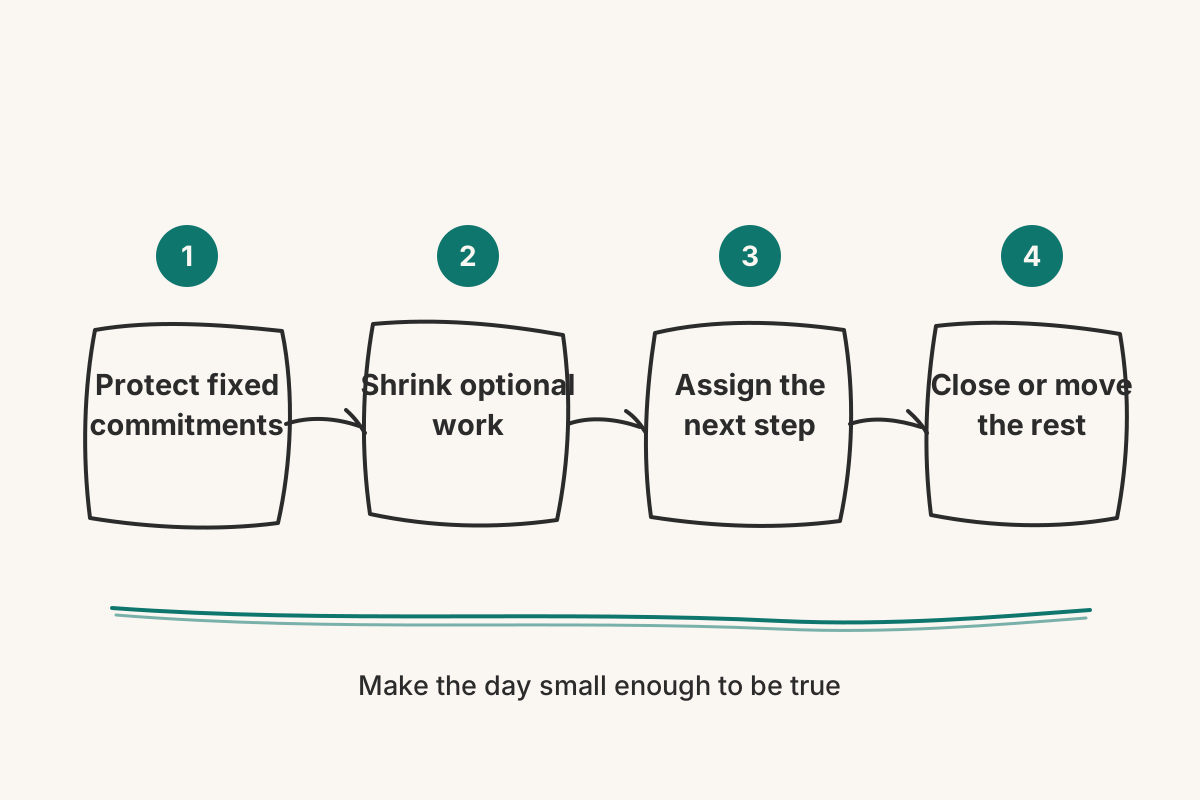
Check that every item still visible for today has an owner and an observable result. Check that moved work has a genuine return point. Remove stale reminders for anything deliberately dropped. Sivella supports recurring rhythms and one-off nudges, so a temporary exception can stay temporary rather than altering the household routine forever.
The checklist is complete when another household member can look once and tell what must still happen, who is moving it, and what has calmly left the day. The full household record remains available. Today becomes small enough to be true.