Blog · Use case
An AI household assistant for shared home management
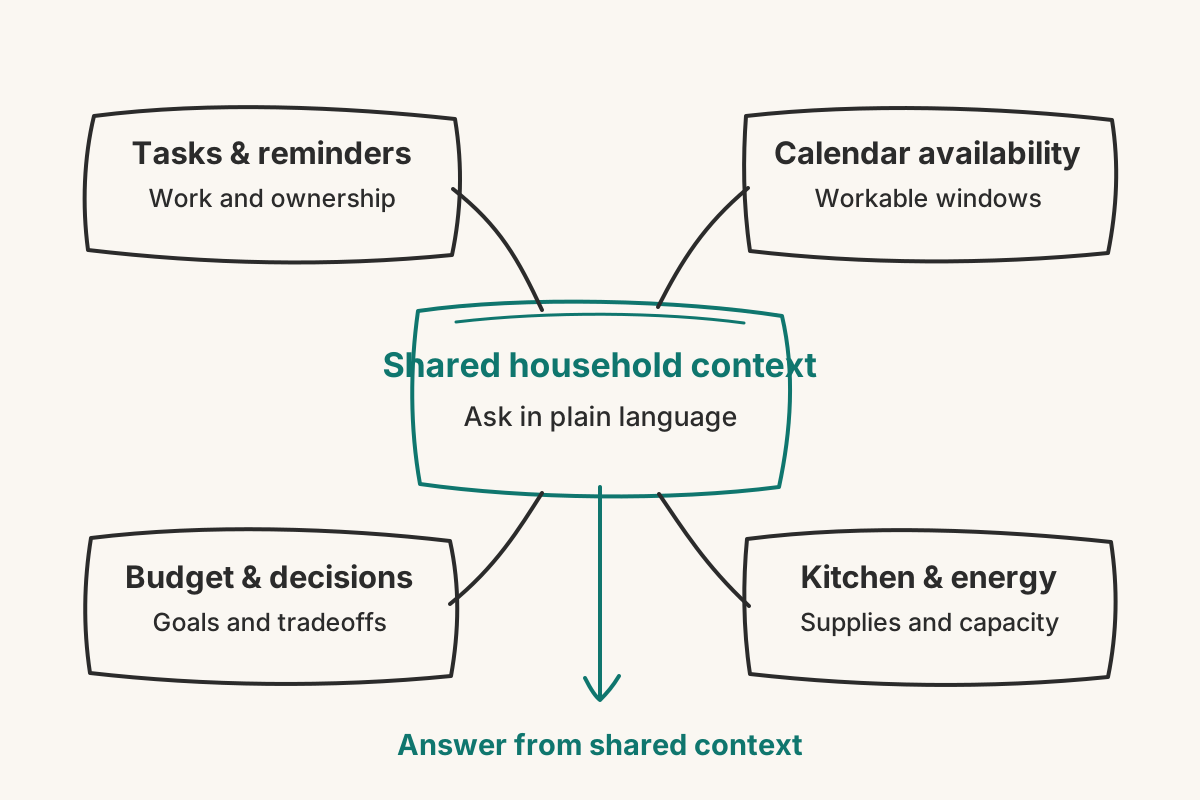
An AI household assistant should answer questions across the work a home shares, not keep each list in isolation. Sivella holds tasks, calendar availability, budget context, decisions, kitchen information, and more in one household context, so everyone can ask in plain language and see what needs attention without returning to one person's memory.
An AI household assistant should answer questions across the work a home shares, not keep each list in isolation. Sivella holds tasks, calendar availability, budget context, decisions, kitchen information, and more in one household context, so everyone can ask in plain language and see what needs attention without returning to one person's memory.
A home rarely presents one clean category at a time. Booking a repair may involve a date, a spending limit, an unfinished choice, and somebody being available. The value of an assistant lies in reading that situation as a household matter rather than sending people through four disconnected records.
When does a home need an assistant rather than another list?
Lists are good at preserving items. They are less good at answering questions whose pieces sit in different places. A note may say that the boiler needs attention while the available afternoon sits on a calendar, the agreed limit sits in the budget, and the quote still being considered sits in a message thread.
An assistant becomes useful when those pieces already belong to the same shared record. The household can ask about the situation instead of remembering which app contains each clue. This is not project management moved into the kitchen. The purpose is shared operational context: enough information for a person who did not capture the original thought to understand the next move.
Sivella is designed for households of two or more people rather than for private productivity. Its assistant answers in plain language across every Sivella surface. That places the conversation over the household's work instead of beside a separate stack of lists.
Which household questions need more than one source?
Use questions that sound ordinary. Can somebody meet the engineer this week? What spending is already approaching before the household agrees to a purchase? Is tonight's dinner possible with what is in the pantry? Which open choice is holding up a task?
Each question crosses a boundary. Calendar availability affects the repair. Upcoming spending changes the purchase. Pantry information changes the shopping list and meal plan. Options and constraints explain why a decision is still open. A category-by-category system makes one person assemble those answers before anyone can act on them.
Sivella keeps tasks with owners, decisions with options and constraints, a ledger for goals and upcoming spending, and a kitchen area for the pantry, meals, and shopping. Its Today plan narrows the wider record to what needs attention and the next step. Asking across those surfaces makes the existing context easier for every household member to reach.
What does shared home management include?
Sivella has ten surfaces: Today, tasks, decisions, reminders, calendar availability, budget, kitchen and shopping, energy check-ins, memory, and assistant chat. They cover both visible jobs and the information behind them.
A recurring reminder preserves timing. An assigned task shows who is expected to move. A decision retains the choices and limits that shaped it. An energy check-in records capacity as low, steady, or high so workload can reflect the room people actually have. Memory holds facts the household may need again and remains inspectable and editable by the household.
The surfaces matter together because household work changes form. A discussion about a purchase can become a decision, affect the ledger, and leave somebody with a follow-up. Keeping that chain visible means the assistant can answer from the household's record rather than from whichever fragment one person remembers most clearly.
Where should shared context stop?
An assistant for people who live together still needs boundaries. The home may need to know that Wednesday afternoon is unavailable without knowing what the appointment is. Sivella's calendar availability sync shares free-or-busy information and never exposes event details. It supports availability from Google, Outlook, iCloud, and CalDAV without turning a personal diary into household content.
Energy check-ins draw another line. The capacity level and date are visible to the household; a personal note remains private. Household memory can be inspected, corrected, or removed. Shared context should contain the operational fact people need, not every private reason behind it.
These limits are part of making the assistant usable. People can contribute enough context to coordinate without treating cohabitation as permission to expose the rest of their lives.
How can you tell whether the assistant is genuinely shared?
Choose one question that currently has a single dependable human answer. Ask what needs attention today, what upcoming spend affects a choice, or whether the household has a workable evening for an appointment. Then notice what has to happen before somebody else can answer.
If one person must explain the history, fetch another record, or translate a vague item, the context is not shared yet. Capture the missing fact, clarify the immediate action, and put an owner on that action. Sivella's working loop is capture, clarify, assign, and follow through; open items remain present until resolved or intentionally dismissed.
Repeat the question during a normal week. The test is not whether the assistant produces an elaborate response. It is whether another person can ask in their own words, understand the situation, and take the next step without a briefing. That is when an AI household assistant stops being another tool one person operates and starts serving the home as a shared system.